AI-Powered Travel Agency
A sophisticated travel assistant demo showcasing AI-driven trip recommendations through natural conversation, featuring dual-channel architecture and dynamic UI generation.
Building an AI-Powered Travel Assistant: A Deep Dive into Modern Web Development
Introduction
In the world of portfolio projects, it's easy to fall into the trap of building yet another to-do list or weather app. But what if we could create something that not only showcases technical prowess but also demonstrates a sophisticated understanding of AI integration? Enter the AI-Powered Travel Assistant – a demo application that marries modern web development with intelligent conversation processing to create a truly dynamic user experience.
This project isn't about booking flights or processing payments. It's about demonstrating how AI can transform user interactions into rich, contextual experiences that extend far beyond a simple chatbot interface.
The Core Concept: Beyond Traditional Chatbots
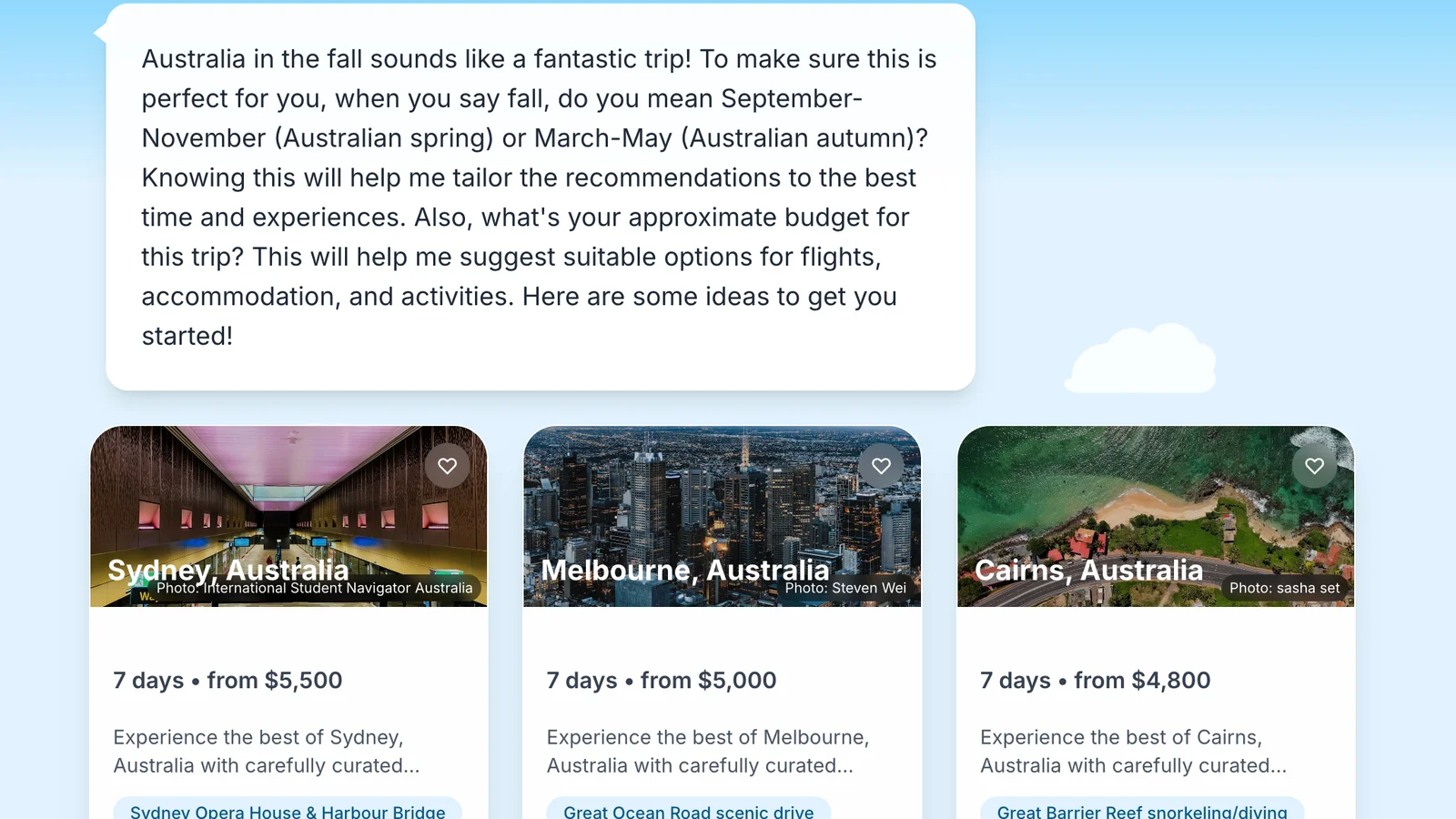
Most AI chatbots follow a predictable pattern: user types, AI responds, repeat. But this travel assistant takes a different approach. When users describe their dream vacation through natural conversation, the AI doesn't just respond with text – it dynamically generates and displays actual trip recommendations as interactive cards within the extended chat interface.
Here's the magic: A user might type "I'm looking for a family-friendly beach vacation under $3000," and while the AI responds conversationally in the chat, the main page simultaneously updates with beautifully rendered trip cards showing specific destinations, pricing, and activities. It's a dual-channel approach that leverages AI for both understanding and presentation.
Technical Architecture: Building for Scale (Even in a Demo)
The Tech Stack
The application is built on a modern, production-ready stack:
- Next.js 15 with App Router for optimal performance and SEO
- React 19.1.0 leveraging the latest features and optimizations
- TypeScript in strict mode for type safety across the entire codebase
- Tailwind CSS for rapid, consistent styling
- Google Gemini 2.0 Flash via
@ai-sdk/googlefor AI processing
This isn't just a random collection of trendy technologies. Each choice reflects real-world considerations: Next.js for performance, TypeScript for maintainability, and Gemini for cost-effective AI capabilities.
State Management That Makes Sense
At the heart of the application is a carefully crafted state management system using React Context and useReducer. The TravelContext manages:
- chatHistory: Array of conversation messages
- recommendedTrips: Current AI-generated recommendations
- savedTrips: User's bookmarked destinations
- activeFilters: Search and filter states
- Rate limiting tokens and session tracking
This centralized approach ensures that chat interactions seamlessly update the UI components across the application, creating that "wow" factor when trip cards materialize based on conversation context.
The AI Integration: A Dual-Channel Approach
Understanding User Intent
The first AI challenge is extracting structured data from unstructured conversation. When a user types something like "We're a family of four looking for adventure but my youngest is only 5," the AI needs to understand:
- Family composition (2 adults, 2 children)
- Activity preferences (adventure-suitable for young children)
- Implicit constraints (family-friendly accommodations needed)
This is where prompt engineering meets practical application. The system uses carefully crafted prompts that instruct Gemini to:
- Extract key travel parameters from natural language
- Match preferences against available destinations
- Consider implicit requirements (like child-friendly activities)
- Return structured JSON that the application can render
The Secret Sauce: Structured Output
Here's where it gets interesting. Instead of just returning chat responses, the AI generates structured data:
interface AITripResponse {
  chatMessage: string
  recommendations: {
    trips: TripRecommendation[]
    totalBudget: number
  }
  followUpQuestions?: string[]
}
This dual output allows the AI to maintain a natural conversation while simultaneously updating the UI with actionable data. It's like having a travel agent who talks to you while pulling out brochures – except it's all happening programmatically.
Smart API Integration: A Sophisticated Hybrid Approach
The application demonstrates a masterful balance between real-world API integration and practical demo constraints. Rather than relying purely on mock data, it integrates multiple travel APIs:
Real API Services
- Amadeus API: Provides real-time flight searches and hotel availability
- OpenWeather API: Delivers current weather and 5-day forecasts
- Geoapify API: Supplies actual tourist attractions and points of interest
- REST Countries API: Offers comprehensive country information (currency, languages, timezone)
The Hybrid Strategy
The system intelligently combines these APIs with curated mock data:
- Real-Time Searches: When users request specific destinations, the app fetches live flight prices, hotel availability, and current weather
- Fallback System: Comprehensive error handling ensures graceful degradation to mock data if APIs are unavailable
- Cost Optimization: Rate limiting and intelligent fallbacks keep API costs under control. In a production environment, strategic caching would further reduce API calls and improve response times
- Enhanced Mock Data: When real APIs provide data, it enriches the mock trip recommendations with live information
This approach results in approximately 60-70% real data for destinations where APIs are available, falling back to high-quality mock data for edge cases. The user sees "Live data: flight prices, hotel availability, current weather" or "Curated data: accommodation options" messaging for transparency.
Intelligent Data Resolution
The system includes sophisticated destination resolution:
// Handles variations like "Rome, Italy" → proper API calls
// Resolves "Southern Italy" → "Italy" for country data
// Maps city names to IATA codes for flight searches
This hybrid approach demonstrates production thinking while maintaining demo viability – showcasing the ability to balance real-world constraints with technical excellence.
The User Experience: Where Tech Meets Delight
The application features a playful tropical theme with animated palm trees, floating clouds, and gentle waves. But these aren't just decorative – they serve a purpose:
- Loading States: Animations provide visual feedback during AI processing
- Responsive Design: Mobile-first approach ensures the experience works everywhere
- Accessibility: Careful attention to contrast ratios and keyboard navigation
The chat interface itself follows conventional patterns (because familiarity breeds usability), while the dynamic trip cards provide the "wow" factor.
Production Considerations in a Demo Context
Even though this is a portfolio piece, it demonstrates production-level thinking:
Rate Limiting and Cost Control
- IP-based session tracking limits users to 5 conversations per day
- Token counting prevents runaway AI costs
- Daily spend caps ensure predictable expenses
Security Measures
- Input sanitization prevents prompt injection
- Content length limits protect against abuse
- Environment variables keep API keys secure
Performance Optimization
- Server components where possible for better initial load
- Intelligent use of client components only where needed
- Optimized image loading and lazy rendering
The Portfolio Angle: What This Demonstrates
For potential employers or clients, this project showcases:
- AI Integration Expertise: Not just using AI, but understanding how to extract and transform data
- Full-Stack Capabilities: From React components to API integration
- Production Thinking: Rate limiting, error handling, and cost considerations
- User Experience Design: Balancing functionality with delight
- Modern Best Practices: TypeScript, proper state management, and clean architecture
Technical Deep Dive: The Data Extraction Pipeline
Let's look at how user input transforms into UI updates:
- Input Processing: User message enters through the chat interface
- Context Enrichment: Previous conversation history provides context
- AI Processing: Gemini analyzes the full conversation context
- Data Extraction: Natural language converts to structured JSON
- State Update: TravelContext reducer processes the AI response
- UI Rendering: React components automatically update based on new state
This pipeline demonstrates understanding of both AI capabilities and React's reactive paradigm.
Lessons Learned and Future Possibilities
Building this demo revealed several insights:
- Structured AI Output: The key to dynamic UIs is getting AI to return actionable data, not just text
- Rate Limiting: Essential even for demos to prevent unexpected costs
- Context is King: Maintaining conversation context dramatically improves AI responses
Future enhancements could include:
- Real-time collaboration features
- More sophisticated preference learning
- Integration with actual booking APIs (for a commercial version)
- Multi-language support leveraging AI translation
Conclusion: The Future of AI-Driven User Experiences
This AI-Powered Travel Assistant represents a paradigm shift in how we think about AI integration. Rather than treating AI as a simple question-answer engine, it demonstrates how intelligent systems can orchestrate entire user experiences – understanding context, extracting intent, and dynamically generating interfaces that respond to user needs in real-time.
The dual-channel architecture showcases a sophisticated understanding of AI's true potential: not just as a conversational partner, but as an intelligent backend that can transform unstructured human desires into structured, actionable data. By leveraging AI to bridge the gap between natural language and dynamic UI generation, this project illustrates how modern applications can create truly adaptive experiences.
What makes this approach particularly powerful is the seamless integration of multiple AI capabilities – from natural language understanding to structured data generation, from context retention to intelligent recommendation systems. It's a blueprint for how AI should be integrated into modern applications: invisibly powerful, naturally intuitive, and focused on enhancing rather than replacing human decision-making.
The code is open source, ready for exploration and extension. Because the best AI implementations are those that inspire others to push the boundaries even further.
Ready to Build Something Amazing?
Inspired by this project? Let's discuss how we can bring your ideas to life. Whether you have a specific project in mind or just want to explore possibilities, I'd love to hear from you!